


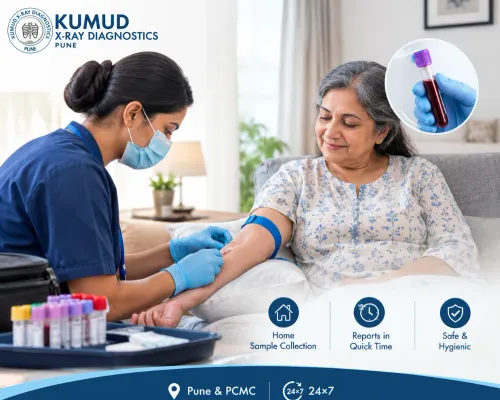
Blood Sample Collection at Home in Pune & PCMC
2026-10-27T08:55:22  read more
 read more



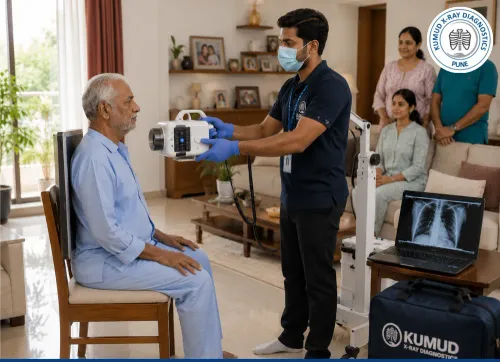
X-rays and CT scans are both medical imaging tests, but they are not interchangeable. Each provides different information, and the right choice depends on the condition a doctor is investigating. Knowing the difference can help patients understand why a particular examination has been recommended. How Does an X-Ray Work? A conventional X-ray uses ionising radiation to create an image of structures inside the body. It is commonly used to examine bones and can also help doctors assess certain chest conditions. An X-ray may be recommended after an injury when a fracture is suspected, or to investigate selected bone, joint or chest concerns. The examination required depends on the patient's symptoms and the doctor's assessment. Portable digital X-ray equipment allows certain examinations to be performed outside a fixed imaging room. For appropriate patients who have difficulty travelling, a home X-ray may be an option when the required examination can be performed safely. How Does a CT Scan Work? A CT scan, short for computed tomography, takes X-ray images from multiple angles and processes them into cross-sectional views of the body. These images can provide more detailed information about particular internal structures. Doctors may recommend CT imaging when a conventional X-ray is insufficient to answer a specific clinical question or when detailed imaging is needed for a suspected injury or medical condition. A CT scan requires specialised scanning equipment. A portable X-ray examination at home does not provide the same type of imaging and should not be used as a substitute when CT is required. Main Differences Between the Two Tests Type of image: An X-ray produces a two-dimensional projection image, while a CT scan creates cross-sectional images. Purpose: X-rays are often used for selected bone and chest examinations. CT scans help investigate conditions that require more detailed imaging. Radiation exposure: Both tests use ionising radiation. The exposure depends on the examination and protocol, and the medical team considers the expected benefit before recommending imaging. Where the test is performed: Some X-rays can be performed using portable equipment at home. CT scans require specialised equipment at an imaging facility or hospital. How Does a Doctor Decide Which Test Is Needed? The doctor considers the symptoms, examination findings, medical history and the information required to make a diagnosis. A conventional X-ray may be sufficient for some conditions, while others need CT or another type of imaging. For example, a suspected fracture may initially be investigated with an X-ray, but some complex injuries require additional imaging. A normal X-ray does not always exclude every injury or medical condition. Patients should not request a CT scan or X-ray solely based on convenience. The appropriate test should be guided by clinical advice. Home Diagnostic Services in Pune & PCMC For selected patients, portable X-ray at home may help reduce the difficulty of travelling for an examination. It may be useful for some elderly patients and people with limited mobility, provided the examination is appropriate and safe to perform at home. Kumud X-Ray Diagnostics provides portable X-ray at home, ECG at home and blood sample collection across Pune and PCMC, subject to availability and clinical suitability. Frequently Asked Questions 1. Which is more detailed: an X-ray or a CT scan? A CT scan provides cross-sectional images and can show more detail for certain clinical questions. The best test depends on what needs to be investigated. 2. Can I have a CT scan at home? CT scans require specialised equipment and are generally performed at a diagnostic imaging facility or hospital. A portable X-ray is not equivalent to a CT scan. 3. Is an X-ray enough to detect every fracture? No. Some injuries may not be visible on an initial X-ray. A doctor may recommend further assessment or imaging if needed. 4. Are both tests associated with radiation? Yes. Both use ionising radiation. The medical team considers the clinical need and uses appropriate protocols. 5. Can I arrange an X-ray at home in Pune or PCMC? Kumud X-Ray Diagnostics offers home X-ray services across Pune and PCMC, subject to availability and clinical suitability. Important: Serious injuries and emergency symptoms require prompt medical assessment. Do not delay urgent care while arranging routine home imaging.
 read more
 read more
We hate spam too.


